In urology, many clinical decisions are based on objective data. It's not enough to know that a patient "urinates worse" or that their stream "has lost force": it's important to measure it. For this, there is a simple, painless test widely used in clinical practice: urinary uroflowmetry.
Although its name sounds technical, it is an easy-to-understand study that provides key information about the functioning of the lower urinary tract, especially in men with prostate symptoms.
What is urinary flowmetry?
Urinary flowmetry is a test that measures the speed and pattern of urine flow during urination . Simply put, it analyzes how urine flows when a person urinates naturally.
The result is represented in a graph that reflects:
- How much urine is eliminated
- At what speed
- For how long
- And what is the shape of the curve?
It's a basic test , but of great diagnostic value . It's painless, non-invasive, and provides essential information for understanding many common urinary problems, especially in men of a certain age.
What is flowmetry used for?
Uroflowmetry allows us to detect any degree of obstruction or difficulty urinating . It is especially useful in the study of:
- Lower urinary tract symptoms.
- Benign prostatic hyperplasia (BPH).
- Bladder muscle weakness.
- Follow-up after prostate surgery.
- Evaluation of urological treatments.
This test provides a diagnosis on its own, but it gives the urologist a lot of guidance and helps decide if further tests are needed.
How is the test performed?
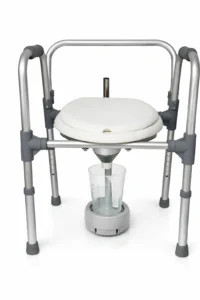
The test is very simple and non-invasive. The patient urinates into a toilet-like device connected to a measuring system. There are no catheters, needles, or pain.
It's important that urination be as natural as possible. Therefore, it's recommended to go when you feel a normal urge to urinate , without straining your bladder excessively or arriving in extreme urgency.
During urination, the device automatically records the data and generates a graph that the urologist later interprets.
What information does flowmetry provide?
Flowmetry provides several key parameters. Among the most important are:
- El maximum flowThis indicates the highest speed at which urine flows out. When it is low, it may suggest a prostatic obstruction or other urinary tract problems.
- El voiding volumewhich reflects how much urine has been expelled. For the test to be reliable, it is usually necessary to urinate a sufficient volume.
- La shape of the curvePerhaps the most revealing piece of information. A bell-shaped curve is usually normal. Flattened, irregular, or prolonged curves may indicate obstruction or abnormalities in bladder contraction.
Does uroflowmetry detect prostate problems?
It can suggest them, but not confirm them on its own. Low flow is consistent with prostate enlargement, but it can also be due to other factors. Therefore, uroflowmetry is usually complemented with ultrasound, prostate examination, and clinical analysis.
Its great advantage is that it provides objective and reproducible information, very useful for both diagnosis and monitoring.
Does it have any special preparation?
In general, it doesn't require complex preparation. Simply:
- Drink fluids regularly before the test.
- Avoid urinating right before going to the test.
- Follow the center's instructions.
It is a quick test that is usually performed in a few minutes.
Do you notice any changes in the way you urinate?
If you've noticed your urine flow is weaker than usual, you're taking longer to urinate, or you feel like you're not completely emptying your bladder, a uroflowmetry test can be the first step to finding out . At ROC Clinic, we perform comprehensive and personalized urological studies to provide you with a clear diagnosis and a treatment plan tailored to your needs. Requesting an evaluation early can make all the difference.