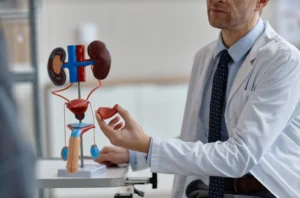

The urodynamic study or pressure/flow study is a test performed in urology and gynecology to better understand how urination works and how the bladder behaves in people affected by some urinary symptom.
This examination is performed on people whose initial studies have not been sufficiently enlightening and in whom a deeper understanding of the cause of urinary problems is needed in order to make sound treatment decisions.
Urodynamic testing can detect urinary obstructions , determine the percentage of urine retained, and assess the amount of urine flowing back from the bladder to the kidneys and the pressure involved. In cases of urinary incontinence , it helps determine the type. It also provides important information for the diagnosis and treatment of pelvic pain and pelvic organ prolapse. It is particularly important when considering the placement of an artificial sphincter.
How is the urodynamic study performed?
The test consists of provoking and reproducing the patient's symptoms to obtain a graphic record of what is observed and to measure a series of variables such as the flow of urine that is able to be produced, the capacity of the bladder and the pressure it generates, the pressures exerted by the sphincter, etc.
The urodynamic study consists of two phases:
- Bladder filling phase: It measures the different pressures that occur in the bladder when saline is introduced through a urinary catheter, as well as the intra-abdominal pressure through the insertion of saline through a rectal catheter.
- Bladder emptying phaseThe patient empties their bladder through urination while data is recorded for analysis by the specialist.
This allows us to understand how the urinary bladder behaves when filling (filling phase) and during urination (emptying phase), and to explore the presence and severity of urinary incontinence, as well as its causes. The resulting graphs show lines of different colors that reflect bladder, rectal, and detrusor muscle pressures, and whether urine leakage occurs during filling.
The urodynamic study lasts approximately 20 minutes and is painless , although the insertion of the two probes may be somewhat uncomfortable.
No special preparation is required from the patient. However, in very specific situations, it may be necessary to rule out the presence of infection before the test to avoid complications and ensure that the data obtained is reliable and not caused by the presence of a germ.
The test results are immediate and will be provided to you at the time along with a report that interprets the data obtained.
Are there any risks or side effects of the urodynamic study?
Urodynamics is a safe and reliable test that is performed on an outpatient basis.
Possible adverse effects are almost nonexistent, although there is a possibility of urethral injury due to catheterization or urinary tract infection. For this reason, your doctor may recommend antibiotics before or immediately after the procedure.
After the examination, some people report that their urinary symptoms worsen. This is normal due to the insertion of the catheters. These symptoms usually disappear in the days following the test. If they are bothersome, they can be treated symptomatically with medication.
In summary, urodynamic testing is a diagnostic test that helps understand complex cases of urinary symptoms that are not easy to diagnose. Although it is an uncomfortable test, it is not painful and lasts about 20 minutes with a very low incidence of complications.