







Benign Prostate Hyperplasia

Changes in urination can be one of the first signs of prostate enlargement

Benign prostatic hyperplasia, also known as prostate enlargement, is one of the most common diseases in men over 40 and can make it difficult for urine to flow.

( * Required fields)

What is it?

Benign prostatic hyperplasia (BPH) is the enlargement of the prostate gland , which, due to its anatomical position, obstructs the flow of urine from the bladder. It is a common condition that affects men as they age.

This growth is not cancerous and is not related to prostate cancer, but it can interfere with the normal flow of urine by compressing the urethra. Although it is a benign process, its progression can significantly impact quality of life if not treated properly.

Benign prostatic hyperplasia (BPH), or enlarged prostate, primarily manifests after the age of 40. By this age, 40% of men experience symptoms of this condition, mainly manifesting as changes in urinary function. This percentage increases by 10% with each passing decade, meaning that virtually all men over 80 will have urinary problems.

At ROC Clinic , we have a team specializing in the comprehensive approach to BPH, offering personalized solutions and minimally invasive technologies that allow us to treat this condition safely, effectively and with a quick recovery.
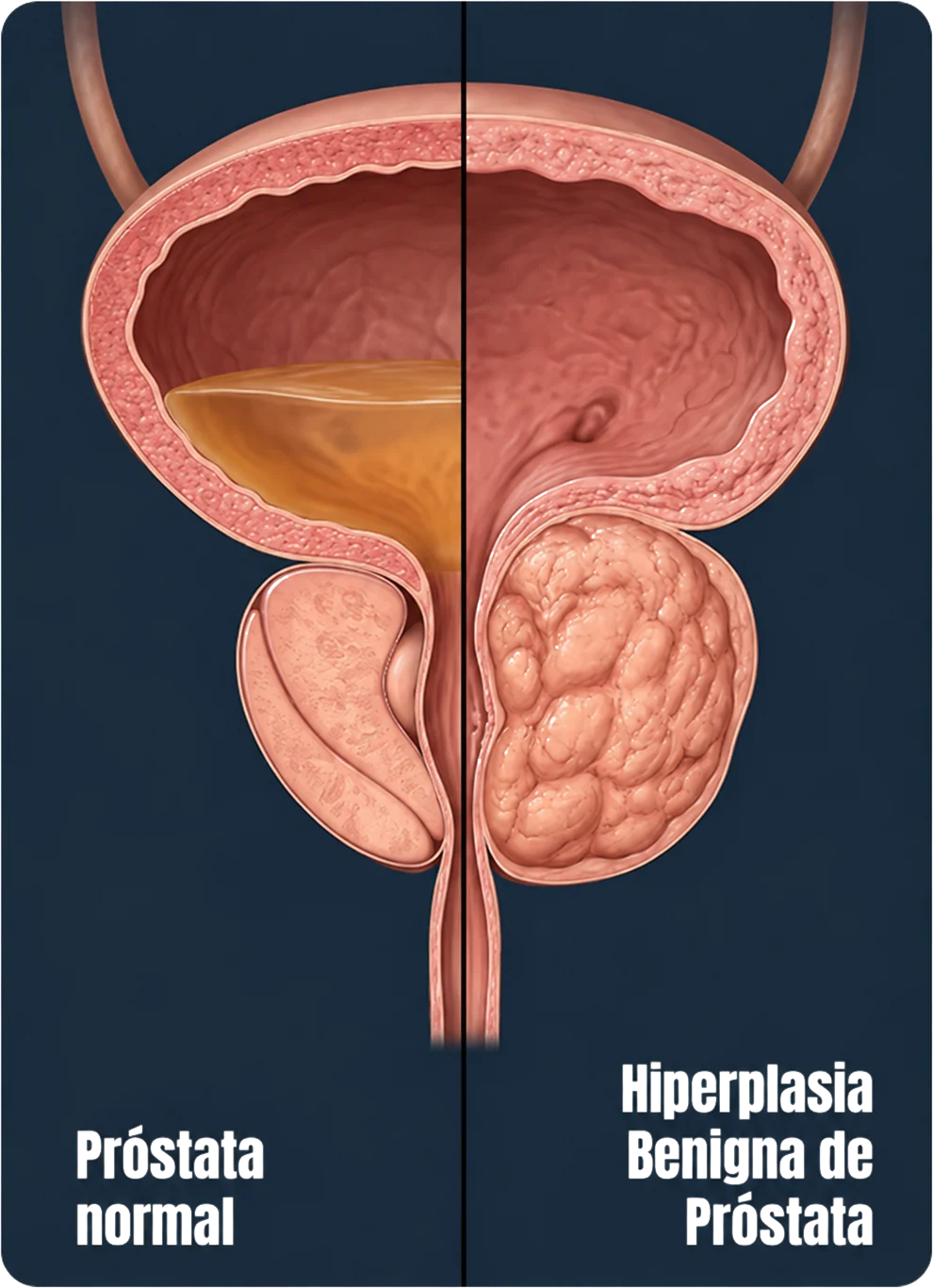
Benign prostatic hyperplasia (BPH) can cause a range of urinary symptoms that significantly impact quality of life. As the prostate enlarges, it puts pressure on the urethra, making it difficult to urinate and disrupting normal bladder function.

Symptoms can vary in intensity and progress over time. Generally, they fall into two groups:

Obstructive symptoms

  • Difficulty initiating urination.
  • Weak or intermittent urine flow.
  • Sensation of incomplete bladder emptying.
  • Post-micturition dribbling.

Irritative symptoms

  • Increased urinary frequency, especially at night (nocturia)
  • Urgency or imperative to urinate.
  • Burning sensation or discomfort when urinating.

Urinary symptoms can have various causes. One of the most common is benign prostatic hyperplasia (BPH), but it's necessary to rule out others such as narrowing of the urinary tract (urethral stricture), bladder tumors , bladder stones, urinary tract infections , and so on. Therefore, it's important to see a urologist if you experience any changes in your urinary pattern.

The exact cause of benign prostatic hyperplasia (BPH) is unknown, but it is believed to be related to hormonal changes that occur with aging. The following are some factors that may contribute to the development of this condition:

  1. Hormonal changesAs men age, testosterone levels decline while estrogen levels may remain the same or even increase, which could contribute to prostate growth.
  2. Genetic factorsGenetic predisposition may play a role in the development of benign prostatic hyperplasia (BPH), also known as enlarged prostate. If there is a family history of prostate problems, a man is more likely to develop this condition.
  3. AgeBenign prostatic hyperplasia (BPH) is uncommon in men under 40, but its prevalence increases significantly with age. By age 60, approximately half of all men experience symptoms of an enlarged prostate, and this figure rises to around 90% by age 85.
  4. Lifestyle factorsObesity, lack of exercise, and an unhealthy diet can increase the risk of BPH. Maintaining a healthy lifestyle can help reduce this risk.

Diagnosing benign prostatic hyperplasia (BPH) is complex due to the prostate's interaction with adjacent organs and the nonspecific nature of its symptoms. It is essential to determine the cause of the problems and, above all, rule out bladder cancer. Secondly, it will be necessary to understand the extent of the prostate problems, their severity, and potential complications in order to establish the most accurate diagnosis and address them with the most appropriate treatment.

Generally, we establish three levels of diagnosis:

  • Initial diagnosticsThis is the test we perform on all men with symptoms suggestive of prostate problems. It is usually done with a renal and prostate ultrasound and a PSA blood test.
  • Diagnosis in case we want to rule out other causes For prostate symptoms that were not clearly explained by previous tests, we can perform a urine cytology or cystoscopy to rule out bladder cancer. For urethral stricture, urethroscopy or voiding cystourethrography (voiding cystourethrography) is very useful. If the ultrasound suggests the presence of bladder stones, we can perform a CT scan and cystoscopy.
  • Some patients with urinary symptoms due to benign prostatic hyperplasia need to undergo supplementary testsThese may include: prostate biopsy if prostate cancer needs to be ruled out; cystoscopy if we want to appreciate the anatomy of the prostate internally; transrectal prostate ultrasound to determine the size of the prostate more accurately, usually in preparation for surgery; and, in selected cases, urodynamics to learn more about prostate obstruction and its impact on urination.

Thus, the diagnosis begins with an assessment of your medical history and the performance of a series of questions and tests:

  • Measuring symptoms through a questionnaireThe most commonly used is the so-called IPSS (Prostate Symptom Scale).
  • Physical examination using rectal examination to assess the size, shape, and consistency of the prostate.
  • Urine analysis to rule out an infection or other conditions that can cause similar symptoms.
  • Blood Tests To rule out kidney problems and measure the levels of a substance produced in the prostate called prostate-specific antigen (PSA). Levels of this substance increase in cases of prostate enlargement, although elevated levels can also be due to recent procedures, infection, surgery, or prostate cancer.
  • Urinary flow test (uroflowmetry): This involves urinating into a container connected to a machine that measures the force and volume of urine flow. The results help monitor the progression of the condition and determine whether it is improving or worsening over time.
  • Bladder ultrasound to determine if there is any urine left after emptying the bladder.

To rule out the presence of a bladder tumor, urethral stricture, urinary tract infection, bladder stones, or overactive bladder, tests such as renal, bladder, and prostate ultrasound and urine cytology will be performed. In this regard, urethrocystoscopy may be useful if urethral stricture or the presence of a bladder tumor is suspected—either by ultrasound or following an abnormal cytology result.

Once the above has been ruled out, it will be determined whether benign prostatic hyperplasia (BPH) may be causing complications secondary to obstruction, such as bladder stones, recurrent urinary tract infections, chronic urinary retention, hydronephrosis, or chronic kidney disease. For this purpose, we use ultrasound and perform a blood test to determine kidney function.

Additionally, the risk of prostate disease progression will be calculated using PSA levels and prostate volume (measured by ultrasound). Men with prostates larger than 40 cc and PSA levels >1,5 have a higher risk of symptom progression within five years and will therefore require more intensive treatment. In men with smaller prostates or lower PSA levels, especially those with fewer symptoms, a more conservative approach to treatment is possible.

Finally, tests are performed to help detect bladder obstruction. The simplest is urinary uroflowmetry, which measures the volume of urine passed per unit of time.

In cases where greater diagnostic power is needed, urodynamics can be performed. This is a more invasive test that involves inserting a small bladder and rectal catheter to measure bladder and abdominal pressures.

Treatments for benign prostatic hyperplasia (BPH) vary depending on the severity and intensity of the symptoms. We can distinguish between medical and surgical treatment:

Medical treatment

It is the treatment for most men with mild to moderate urinary symptoms. The risk of progression of prostate problems, which can reach up to 30% in enlarged prostates, must be considered, as well as the efficacy and safety profile. Some prostate medications can cause sexual problems such as impotence, anejaculation, or decreased libido.

  • Phytotherapy. These are plant extracts that help improve urinary symptoms. It is indicated for mild to moderate symptoms without complications. It does not produce side effects on sexual function. 
  • Alpha blockers. These medications "open" the bladder neck and reduce symptoms, facilitating urination. They do not alter the natural course of the disease, so they could be considered "prostate painkillers." They have two side effects to be aware of: low blood pressure and a decrease, or even elimination, of sperm during orgasm.
  • 5-alpha-reductase inhibitors. These medications are indicated for prostates larger than 40cc to reduce their size and improve urine flow by blocking an enzyme that the body needs to produce dihydrotestosterone.

Its effects take some time to appear, but this treatment reduces the risk of complications and the need for surgery in the long term. The main drawbacks are decreased libido and possible erectile dysfunction.

Surgical treatment

When significant symptoms or complications arise, surgery is the best option. Among the surgical options are minimally invasive procedures that allow for very short hospital stays and minimize the risk of complications.

Classical techniques

  • transurethral resection of the prostate (TURP). Benign prostatic hyperplasia (BPH) of less than 60 cc has traditionally been treated with transurethral resection of the prostate (TURP). This involves the gradual removal of the prostatic adenoma through the urethra using a standard scalpel, without incisions. This technique can lead to several complications, such as bleeding, fluid absorption, or the need for reoperation in the medium to long term.
  • Open surgery. When the adenoma is larger than 60 cc, open surgery was traditionally required, as it was not possible to remove all the tissue through the urethra. This technique is much more invasive, but it successfully removes the entire prostatic adenoma, preventing the disease from recurring. While effective and definitive, it has significant associated morbidity and mortality: bleeding, a high percentage of blood transfusions, surgical wound, hospitalization, and prolonged bladder catheterization. Recovery and return to daily life are slower.

Modern Technologies

  • Holmium Laser Electrode Process (HoLEP). The most powerful and safest treatment for prostate obstruction is Holmium Laser enucleation of the prostate (HVE). It is suitable for all prostate sizes and is as effective as open surgery, but with significantly less trauma and far fewer complications. At ROC Clinic, we have over 15 years of experience with this technique and have performed more than 3.500 HVE procedures.

SEE HOLMIUM LASER

  • Thulium Laser (ThuLEP). The Thulium laser prostate vaporization technique allows the vaporization of prostate tissue through energy emitted continuously, unlike the Holmium laser, which does so in pulses.

SEE THULIUM LASER

  • AquaBeam. This is a robotic treatment that vaporizes prostate tissue using water. It is a very safe procedure with virtually no side effects such as incontinence, erectile dysfunction, or ejaculation problems. It is effective for medium and large prostates.

SEE AQUABEAM

  • Rezum. This treatment involves injecting water vapor into the prostate, clearing the lower urinary tract and improving symptoms. It does not cause side effects such as incontinence, erectile dysfunction, or anejaculation. It is effective for small to medium-sized prostates. This treatment is only suitable for strictly selected patients, chosen based on a series of personal, clinical, and anatomical parameters, with mild prostate conditions and prostates no larger than 80 cc. It is often presented as an alternative to medication.

VER REZUM

FAQ

Benign prostatic hyperplasia (BPH) is not cancer, nor does it increase the risk of developing it; therefore, it is not a dangerous disease in itself. However, if left untreated, it can lead to significant complications that seriously affect health and quality of life. Possible consequences of uncontrolled BPH include: acute urinary retention (inability to urinate), recurrent urinary tract infections, bladder stone formation, and progressive damage to the bladder or kidneys. Therefore, even though it is not malignant, it does require medical attention and urological follow-up. With early diagnosis and appropriate treatment, BPH can be effectively controlled, preventing complications.
It's good to drink at least 2 liters of water a day and avoid foods high in saturated fats, spices, hot peppers, and chili peppers. It's also advisable to reduce your intake of coffee and alcohol, especially spirits and beer.
Depending on the treatment, this can happen. Open surgery and Holmium laser enucleation of the prostate are the two treatments that completely remove the tissue, preventing it from recurring. In any case, the specialist will assess the best treatment option for you and inform you of the pros and cons of each.
Depending on the treatment used, it can affect a patient's ejaculation. It is important to discuss this with your urologist.
If BPH is not treated promptly, it can cause more serious complications such as blood in the urine. However, it is more common in conditions such as urinary tract infections; bladder, prostate, or kidney cancer; kidney disease or injury; and so on. It is vital to see a doctor as soon as possible.
The prostate gland helps us maintain good urinary continence. It also produces a large part of the seminal fluid, which is like "fuel" for sperm.
There are many, but some of the most common are: getting up to urinate at night, urinating many times upon waking in the morning, a few drops falling out at the end of urination, a weak urine stream, having to strain to start urinating.
We may only need to do an ultrasound of the prostate, bladder and kidneys, along with a blood test.
Yes, some prostate medications worsen erection, sex drive, and ejaculation, but there are alternatives to improve symptoms without suffering side effects.
Not at all. In recent years, we have increasingly advanced technology that allows us to perform minimally invasive prostate surgery without causing sexual side effects.
Yes, very much so. Prostate problems can cause impotence and premature ejaculation. That's why early treatment of benign prostatic hyperplasia (BPH) can sometimes prevent you from developing sexual problems.

Our centers
urology

We treat our patients at the ROC Chamberí clinic and in the HM Hospitals network of centers in Madrid: Sanchinarro, Montepríncipe, Madrid Río, Rivas, Puerta del Sur, Nuevo Belén, Policlínico HM Moraleja and Nuevo Norte. 

ROC Chamberí

Coming soon

ROC Bernabéu

ROC HM Sanchinarro

ROC HM Montepríncipe

ROC HM South Gate

ROC HM Madrid Río

ROC HM Rivas

ROC HM New Bethlehem

ROC HM New North

ROC Polyclinic HM Moraleja

Our centers
urology

We treat our patients at the ROC Chamberí clinic and in the HM Hospitals network of centers in Madrid: Sanchinarro, Montepríncipe, Madrid Río, Rivas, Puerta del Sur, Nuevo Belén, Policlínico HM Moraleja and Nuevo Norte. 

ROC Clinic

Urology in Madrid

4,8 ★ ★ ★ ★ ★★ ★ ★ ★ ★
make an appointment now
★ ★ ★ ★ ★★ ★ ★ ★ ★ Verified rating

We left very happy with the doctor-patient relationship

JG August 6, 2026

View all ratings (43)
Powered by TOPDOCTORS

The experience of
our patients

Our patients' trust reflects our commitment to providing excellent, personalized, and attentive urological care. Every experience motivates us to continue improving and offering the care and support each patient needs.


4,7
★★★★★ 94 reviews published in Google
Leave us a review on Google

Related articles

Can benign prostatic hyperplasia increase PSA levels?

Benign prostatic hyperplasia (BPH) can increase PSA levels without necessarily indicating prostate cancer. There is no set value...

Prostate cancer: preventing, detecting early and treating better

Prostate cancer is the most common tumor in men and often develops without symptoms in its early stages. Early detection, checkups...

Urinary flowmetry: what it is, how it is performed, and what information it provides

In urology, many clinical decisions are based on objective data. It is not enough to know that a patient "urinates worse" or that the stream "has lost..."